
Hyundai Corporation Chairman Chung Mong-Hyuk, “We Will Accelerate New Business with Management Buyouts”
Speaking at the 2025 GSC to set a business strategy
HC achieved a record high operating profit last year
Despite new records, the importance of future business is increasing
“Will deliver tangible results on buyout deals this year”
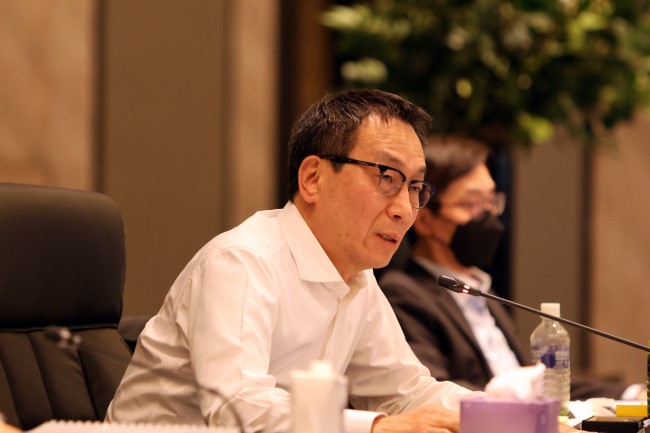 On the 5th at the Four Seasons Hotel, Hyundai Corporation Chairman Chung Mong-Hyuk speaks at the 2025 GSC [Courtesy of Hyundai Corporation]
Hyundai Corporation (HC) Chairman Chung Mong-Hyuk has chosen “management buyouts” as the topic for this year. This is a strategy aiming to reduce trial and error when entering new businesses that HC is focusing on, such as automobile parts and recycling products.
“To maintain the momentum of growth, we need to accomplish buyout deals, which is our top priority,” Chairman Chung said at the 2025 Global Strategy Conference (GSC) held at the Four Seasons Hotel Seoul from February 3 to 6. The GSC is an annual gathering of more than 40 overseas subsidiaries and branch managers to discuss business strategies for the year ahead.
The buyout deals that Chairman Chung mentioned are transactions in which a company buys a stake in another company as part of an M&A to gain control of the business. “Last year, we made many attempts (for a buyout deal), but, unfortunately, we did not achieve the desired outcomes,” said Chairman Chung. ”Based on the lessons learned and experiences gained, we will achieve tangible results this year.”
Despite the recent global uncertainty, HC posted an operating profit of KRW 133.5 billion last year, the highest in its history. The company’s performance was boosted by the rising value of the dollar it receives in the course of trading business.
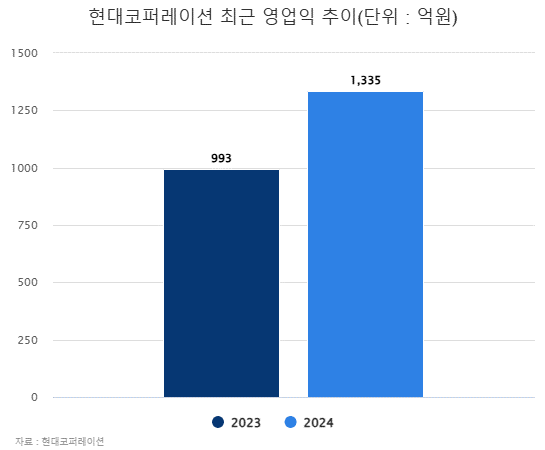 The Recent Operating Profit Trend of Hyundai Corporation (Unit: KRW Billion)
/ Data: Hyundai Corporation
Chairman Chung’s emphasis on buyout deals, despite the record earnings, is driven by the need to diversify its revenue structure. Trading accounts for more than 90% of HC’s total revenue, so if the trading business environment deteriorates, HC’s performance will suffer. Consequently, to continue the upward trend, new businesses must be discovered. Other general trading companies are investing in liquefied natural gas (LNG) and secondary batteries to reduce their dependence on the trading business.
“It is very important to continue to advance trading, which is the root of the group, but to realize our vision of building a ‘sustainable 100-year company,’ we must develop our H2 business (distribution business linked to existing trading) and H3 business (businesses unrelated to existing operations),” said Chairman Chung.
Hyundai Corporation is focusing on new businesses such as auto parts and waste resources recycling. In 2023, the company established ‘Sugihara Hyundai Automotive’ in partnership with Sugihara, a Japanese company specializing in interior vehicle products. Sugihara Hyundai Automotive supplies parts to Japanese automakers. HC is also looking to enter the robotics market, which is gaining attention due to rising labor costs.
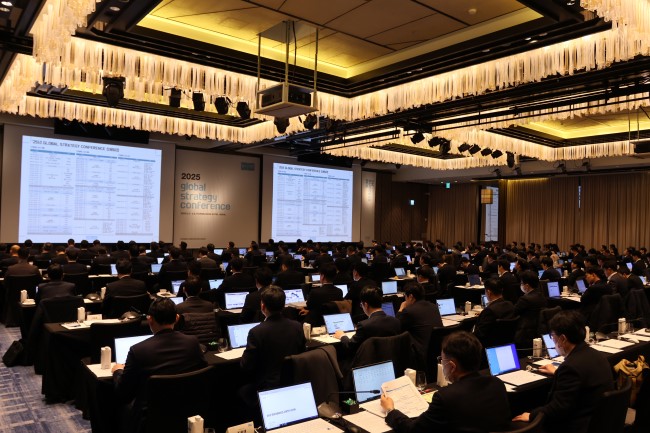
At the conference, Chairman Chung also ordered the strengthening of the NEST system. The NEST system divides the global market into regions rather than countries and creates customized strategies for each region. Until last year, HC operated five NESTs: North, Central, and South America; East, West, and South Asia; Europe and the Commonwealth of Independent States (CIS); The Middle East and Africa; Japan (including Australia and China). Starting this year, the East, West, and South Asia NEST will be subdivided into two regions: Southeast and Southwest Asia.
“We are witnessing an escalation in regionalization and the formation of economic blocs, driven in part by the strong tariff barriers and extreme nationalistic policies of the second Trump administration,” said Chairman Chung. “The company must persist in evolving its sales and management systems to keep up with the fast-changing environment and enhance its capacity to respond to emerging challenges. To navigate the intensifying regionalization and blocification of the global economy, each NEST must play an integral role in converting external uncertainties into opportunities through sustained collaboration, both within regions and across borders.”
Chairman Chung also stressed the importance of digital innovation. This can be achieved by integrating AI into the company’s systems to enhance information transparency and foster a work environment that facilitates constant communication and collaboration between executives and employees, both at home and abroad.
Chairman Chung said, “The ‘AI divide’ is becoming increasingly pronounced across various industries depending on AI utilization capabilities. To avoid falling behind in the AI revolution era, the company will proactively adapt to these changes by strengthening its digital competencies through continuous digital learning.”
February 10, 2025
Herald Business Daily